



Digital security concept with multiple padlock icons and abstract blue and yellow grid background.

SAFE cyber resilience framewok

Assess, prioritise and improve resilience continually

SAFE businesses become more resilient by making prioritised, informed investments.
Strategy, Assessment, Frameworks and Execution cycles deliver reports and actions to drive measurable ROI.

SAFE explained

A clear process that continually assesses and improves resilience

Resilience-focused organisations need more than a one-off technical review and isolated security fixes. With every SAFE cycle, your resilience builds.

A SAFE business can prove it has ...

  • Absolute clarity over holistic cyber resilience status
  • Prioritised investment based on business risk and impact
  • Regular reports to show progress and support GRC
  • Refined insurance scoping
  • Measurably improved resilience posture

Why SAFE matters

Resilience is way more than just a technical concern

SAFE scores resilience across all areas of your organisation, including its ability to grow safely.

Having controls in place is not the same as knowing how resilient you are. SAFE replaces fragmented security with a measurable, defensible resilience strategy.

Leaders use SAFE because they need:

  • Clearer visibility of cyber and resilience gaps
  • Sharper resilience investment planning
  • Sound evidence for board, insurer, and audit conversations
  • Improved confidence in budgeting decisions
  • Security embedded and understood across all teams
  • Clear evidence of progress and improvements over time
Hands holding a phone by a laptop showing a password lock with connected security and user icons.

Value of the SAFE process

Continuous, improving resilience

Threats evolve, business priorities shift, and the attack surface expands. Resilience must by dynamic to keep up.

SAFE is not just a one-off report or cyber health check. It is a cyclical cyber resilience process that drives continuous improvement.

  • Resilience strengthens in a planned, measurable way
  • Previous investment can be reviewed against actual progress
  • New risks can be identified before they become bigger issues
  • Investment decisions are based on current evidence, not outdated assumptions
  • Cyber strategy evolves alongside the business and its risk profile

SAFE turns cyber security from a reactive concern into an ongoing resilience capability.

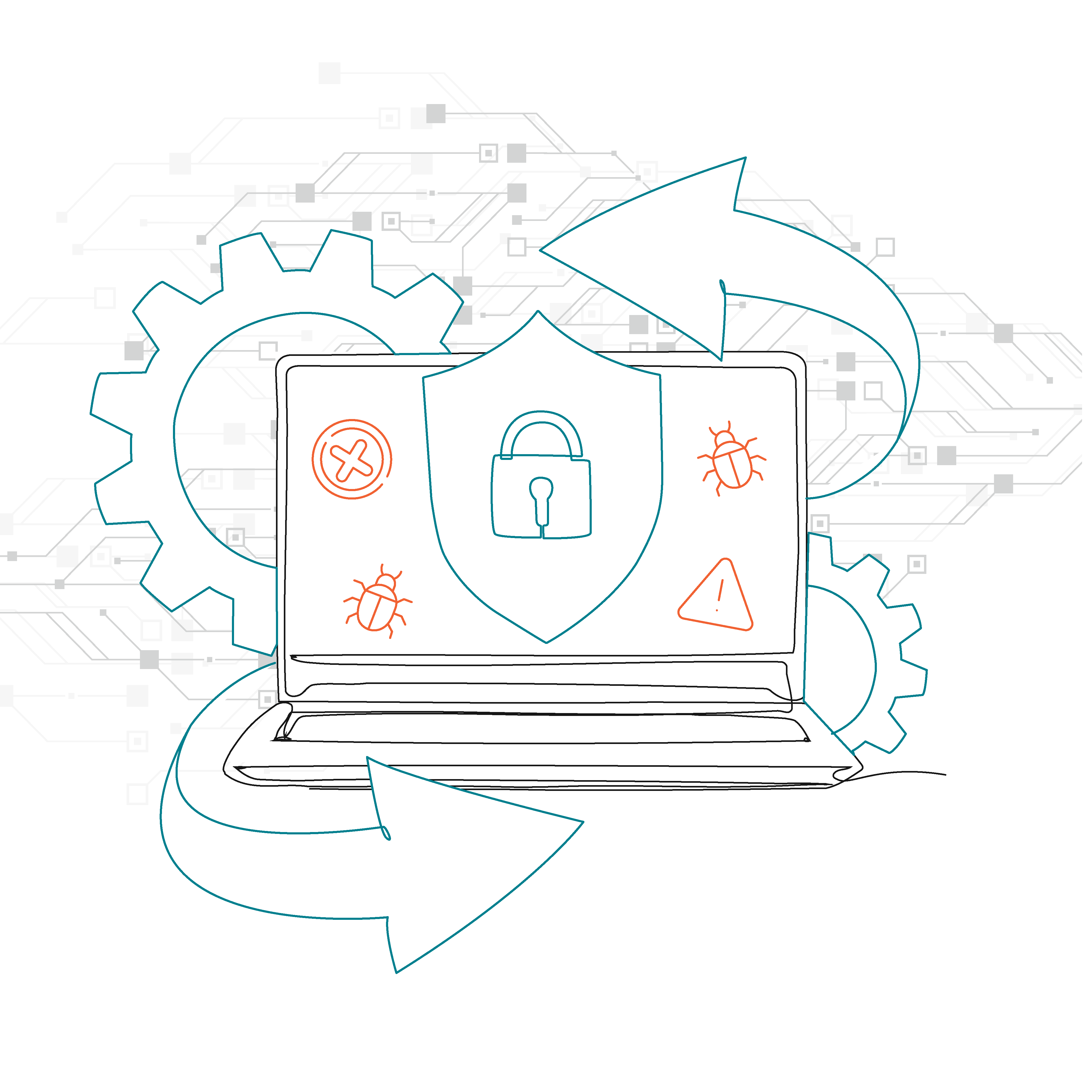
Laptop with security shield and lock icon on screen surrounded by arrows, gears, and warning symbols.

Mark Petar, Head of Systems, Montanaro: SAFE webinar guest

"SAFE from ITHQ is not an audit, it's an evidence-based discussion with proportional outcomes aligned to business needs.  When management sees the old reports compared with the new ones, they can see exactly where [my budget's] gone, where the time and effort's gone ... We can basically prove: 'Look at the difference we've made.' The SAFE reports provide an independent view of our systems like Pen Tests and are 32 pages long: very useful in many regulation-centric scenarios.

The difference in what ITHQ has done for us as a company is just gigantic."
Abstract teal and dark green circular swirl pattern with gradient texture.

The SAFE process

3 steps that build resilience and deliver ongoing ROI

The strength of SAFE lies in its continuity. Each cycle builds on the last, demonstrating improvements made and business impact.

Logo with a white L shape and orange triangle inside on a dark teal rounded square background.

1. Assess

Get a clear, evidence-based view of your cyber resilience, security posture, and maturity. This establishes a realistic baseline and highlights where risk is highest.

Learn More
Square icon with a dark teal border and white center featuring a dark teal X and an orange triangle at the top.

2. Prioritise

Identify the most important gaps, risks, and improvement areas so leadership attention, budget, and action are focused where they will have the greatest business impact.

Learn More
Abstract geometric logo with a white square, dark teal arrows, and an orange triangle.

3. Improve

Turn findings into a practical security roadmap, then review and reassess regularly to strengthen resilience as threats evolve and the attack surface changes.

Learn More

Measurement across 19 domains

Measurement is key to improvement. We use established frameworks to create 19 benchmarked domains and score against them.

Our 19 SAFE domains cover all critical areas and can be grouped into 4 main areas of scrutiny: security policies, data protection, exposure and information security management system (ISMS).

A combination of scorecards, reports and visual data representations deliver a 360 degree view of your resilience profile that enable highly informed board level security investment discussions, and offer proof of improvement activities for GRC and insurance purposes.

The spider graphs below are typical of a visual way in which we demonstrate progress. Each point represents one of the 19 domains, with each concentric line a measure of achievement. Resilient businesses will place all points on the green or blue lines ...

Security Policies: All security policies across the business including security team training and security awareness training for other teams

Data Protection: Identity and access management, user and entity behaviour analysis, secure remote access, endpoint protection and data loss prevention

Exposure: Vulnerability management, network and systems security, asset management, observability, incident response management, business continuity

ISMS: Service provider management, information sharing and collaboration, lessons learned and improvement

Radar chart showing SAFE summary scores with zones for Danger, Warning, Good, and Excellent levels around the scale.

Day zero

Radar chart titled SAFE Summary Score Chart showing score from Danger to Excellent across 20 categories.

6 month retest

Radar chart titled SAFE Summary Score Chart shows initial baseline scores with categories ranging from Danger to Excellent.

12 month retest

Philip Mitchell, IT Director, The Hippodrome Casino

ITHQ has delivered strategy-led, layered solutions to The Hippodrome Casino since 2022. Read the full story ...

Abstract teal and dark green circular swirl pattern with gradient texture.

1. Assess

Understand your current cyber resilience position against industry benchmarks

SAFE: Assess reviews your organisation’s security posture across key resilience domains to establish a realistic baseline

This is not a superficial checklist exercise. SAFE uses our blended framework approach to assess how well your current controls, processes, governance, and operational practices support measurable resilience.

SAFE: Assess:

  • Evaluates current security posture across key resilience domains
  • Establishes a clear cyber maturity baseline
  • Identifies strengths, weaknesses, and potential blind spots
  • Uses evidence and recognised frameworks rather than assumption
  • Creates a strong foundation for decision-making and prioritisation

Assess helps leadership move from uncertainty to an evidence-based understanding of current cyber resilience.

CIS Controls and MITRE logos over a background of hands typing on a laptop with digital padlock icons.

2. Prioritise

Turn findings into clear priorities

SAFE: Prioritise translates evidence into scored analysis, visual summaries, and practical next steps

Teams don't need overwhelming technical detail, they need to know how to reduce risk fast. Prioritise shows where resilience is strongest, where exposure is highest, and which issues need attention first.

SAFE: Prioritise:

  • Converts findings into scores, reports, summaries, and visual outputs
  • Highlights priority risks, maturity gaps, and areas of overexposure
  • Supports stronger board reporting and leadership discussion
  • Gives context for most impactful investment sequence
  • Clearly shows what matters most and why

Prioritise makes cyber resilience easier to explain, easier to govern, and easier to act on.

Bar chart with green, yellow, and red bars showing areas of serious concern and deeper analysis highlighted in red circle.

3. Improve

The road to resilience

Using the outputs from the first two stages, SAFE: Improve creates a practical roadmap for resilience improvement

This action plan pinpoints the most important improvements and aligns them to business priorities, operational reality, and available investment.

SAFE: Improve:

  • Creates a prioritised, practical security roadmap
  • Aligns action with business risk, continuity and investment priorities
  • Drives immediate improvements and longer-term resilience building
  • Provides a basis for reassessment and measureable progress over time
  • Keeps your business adaptive as threats and requirements change

Improve helps organisations move from isolated fixes to a strategic and sustainable resilience model.

Curved path with colorful location markers overlaying a business meeting with smiling professionals.

Latest articles

hands breaking free of chains against sunset
Strategy
The Wicked Tech Problem: You Are a Passenger in Your Own Vehicle

Vendor lock-in is not just a technology issue. Bundling, platform dependency, and reseller bias create resilience risk, says David Thomas.

Read On
muddy rugby players head and shoulders
Strategy
ITHQ Resilience Strategies: Game Plans With The Win Built In

Achieving measurable resilience via strategic tech investment … ITHQ is with you from kick off to triumph.

Read On
Cyber Resilence
Why Rapid7 is the Inaugural Champion of Exposure Management

Rapid7 has defined exposure management. Discover how its Command Platform leads the field.

Read On

Want to know more? Let's talk.

Contact Us